


Open Geospatial Program — Batch #2: AI × Geospatial
What happens when AI gets access to geospatial tools? Batch #2 invites developers, students, data analysts, and technical creators to build and test AI-native geospatial projects with Geoapify OpenAPI specifications, Geoapify MCP, or both.
Build a useful tool or run an experiment, then share the code, process, and what you learned about using Geoapify with AI. Selected projects receive sponsorship, extended API access, and promotion through Geoapify channels.
On this page
Program Summary
Geoapify Open Geospatial Program supports open projects that other developers can run, inspect, and learn from. Batch #2 explores two ways AI can work with location data: coding agents can use Geoapify OpenAPI specifications to build integrations, and AI agents can discover and call tools through Geoapify MCP. Combining both approaches is welcome.
The goal is to publish useful examples and learn where AI handles geospatial tasks well, where it struggles, and how Geoapify's machine-readable interfaces can improve. A focused script, agent, component, or research proof of concept is as welcome as a complete application. See Project Requirements for the deliverables.
Batch #2 - AI × Geospatial
- Applications open: October 1, 2026.
- Application deadline: October 20, 2026, 23:59 UTC.
- Theme: Build with Geoapify OpenAPI & MCP.
- Rewards include EUR 300 sponsorship for selected completed projects plus bonus opportunities. See reward details.
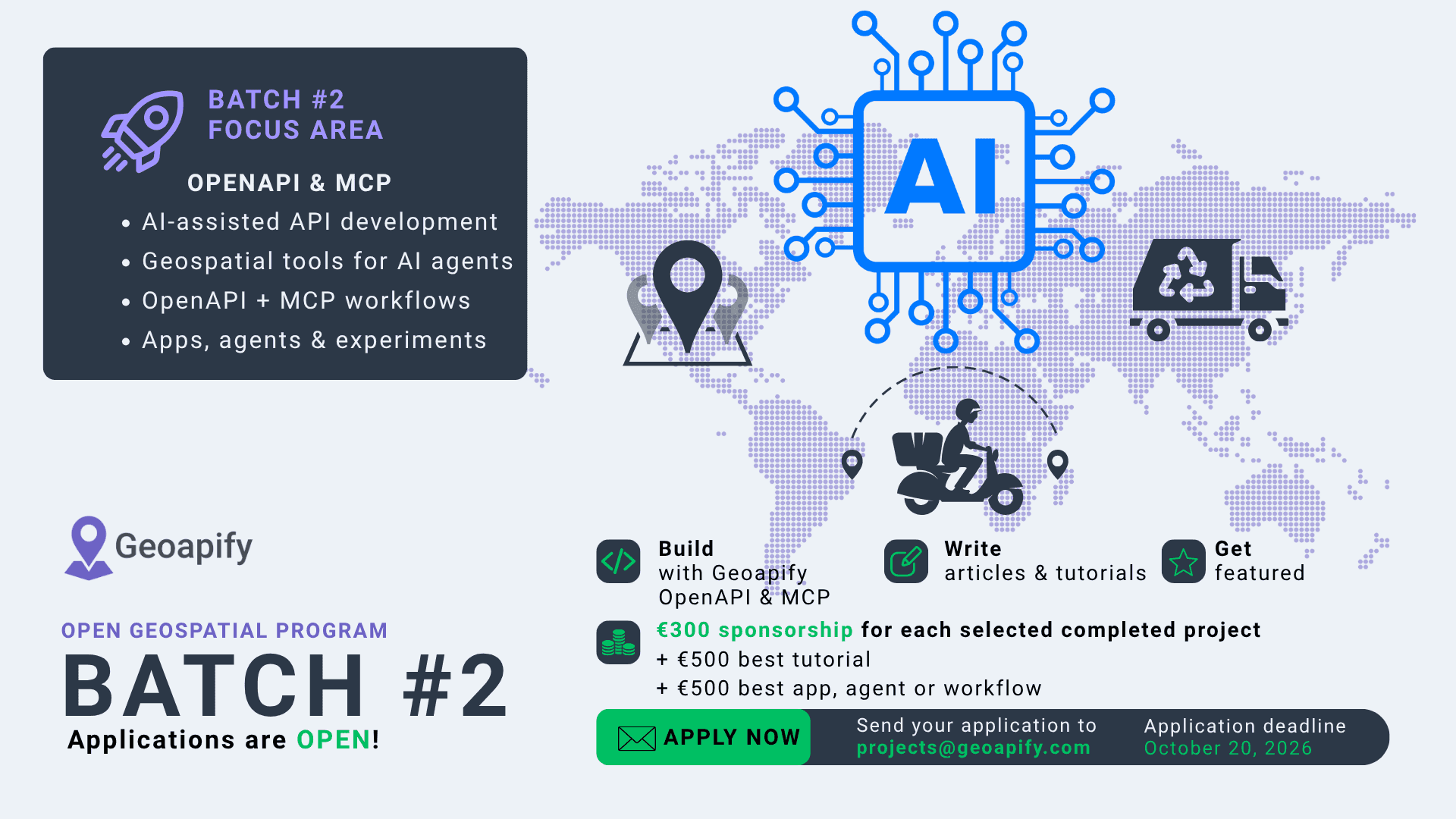
This batch is an invitation to experiment with AI as both a builder and a user of geospatial tools. Use an AI coding assistant to turn OpenAPI descriptions into working code, connect an AI agent to Geoapify MCP tools, or combine the two. Show what worked, what needed human guidance, and what could make the developer experience better.
Choose any format: full application, AI agent, developer tool, reusable component, script, CLI, workflow, automation, or experimental proof of concept. You do not need to ship a complete product.
The suggested categories are Build (create with OpenAPI and AI coding tools), Agent (give an agent Geoapify MCP tools), Automate (combine Geoapify with other services or workflows), and Experiment (test what AI can reliably do with geospatial APIs and tools). Research-style projects are encouraged.
Build Tracks
Choose the approach that fits your question or project. You can work in one track or combine them.
Build with Geoapify OpenAPI
Use Geoapify OpenAPI specifications with an AI coding tool such as Codex, Claude Code, Cursor, or Copilot. Build a web app, script, UI component, CLI, reusable module, data-processing workflow, or a larger application. Show how the machine-readable API description helped the tool understand requests, responses, and integration details.
Use the step-by-step Geoapify OpenAPI guide for API client imports, TypeScript generation, tested prompts, and checks for AI-generated integrations.
Build with Geoapify MCP
Connect an AI agent or workflow to Geoapify MCP Server so it can discover and use geospatial tools. Examples include travel planning, local discovery, logistics, meeting-place search, field service, route and POI exploration, address investigation, property research, and multi-step location questions. Review the MCP tool reference for current capabilities and input schemas.
Combine OpenAPI + MCP
Use MCP for agent-led research or exploration, then use OpenAPI-guided code generation to build the final app or integration. Explain which tasks the agent handled through tools and which tasks your application handles through direct Geoapify API requests.
Starter Challenges
These prompts are starting points, not fixed problem statements. Adapt one or propose your own experiment.
- Build from a prompt: create a useful geospatial app primarily through an AI coding agent and record the prompts and corrections.
- Give an agent a map brain: build an agent that uses Geoapify MCP to answer location questions with real tool results.
- Places + Routes: explore places relative to a route and explain how the workflow combines place search and routing.
- Location Research: answer a multi-step geographic question with traceable tool calls and sources.
- Geospatial Automation: combine Geoapify with another API, service, or agent in a reproducible workflow.
- Surprise us: investigate an interesting OpenAPI or MCP use case, including failures or limitations worth sharing.
What Participants Receive
Selected participants receive:
- EUR 300 sponsorship upon successful project completion.
- EUR 500 bonus per batch for the best tutorial/article.
- EUR 500 bonus per batch for the best app, agent, or workflow.
- Extended Geoapify API access for project development and testing.
- Promotion through Geoapify channels (website, social, and community highlights).
Notes:
- Payouts are arranged with each selected participant. EUR bank transfer is preferred when the recipient can receive a SEPA transfer; other methods depend on availability and eligibility.
- All rewards and participation conditions are defined in Program Terms.
How to Apply for Batch #2
Send a short project proposal to [email protected] between October 1 and October 20, 2026. Applications close at 23:59 UTC on October 20. You need an idea and a realistic plan; the finished project is submitted after selection.
- Choose the OpenAPI, MCP, or combined track and describe the question or problem you want to explore.
- Copy the complete template below into your application email and answer every question. Write "Not applicable" when a question does not apply; do not remove questions or leave fields blank.
- Explain how you will share a runnable or reproducible result and what feedback you expect to collect.
Incomplete applications may not be reviewed. Applications that omit template questions or provide answers that do not address them may be excluded from selection. If clarification is needed, Geoapify may request additional information, but applicants should not rely on a follow-up email to complete the proposal.
Here is the email template:
Subject: Geoapify Open Geospatial Program - Batch #2 Application

1. Who are you?
- Name:
- Role (developer / student / analyst / creator):
- Country / timezone:

2. Project overview
- Project title:
- One-sentence summary:
- What problem, workflow, or AI/geospatial question will you explore?
- Project format and category (Build / Agent / Automate / Experiment):

3. Links (existing resources)
- Your GitHub repository:
- Portfolio / blog / profile:
- Other:

4. Geoapify and AI approach
- Track (OpenAPI / MCP / both):
- Which Geoapify specifications, APIs, or MCP tools do you expect to use?
- Which AI coding tool, AI client, or agent framework will you use?
- How will you capture prompts, tool use, and lessons learned?

5. Deliverables
- Where will the public code be published?
- How will reviewers run or reproduce your project (including AI client setup, if needed)?
- Where will the tutorial or walkthrough be published?

6. Timeline
- Planned start date:
- Planned completion date:

7. Payment availability
- Country where you can receive a payout:
- Which methods can you receive? (EUR bank transfer via SEPA, including Revolut or Wise account details / international bank transfer / PayPal / marketplace gift card / other)
- Do not include account numbers or full bank details in this application.

8. Additional notes
- Anything else we should know?
Project Requirements
Batch #2 accepts applications, agents, tools, scripts, components, automations, and experiments. The final result should be public and reproducible, but it does not need a hosted demo or a complete product. For example, an agent that requires an AI client can provide clear configuration and run instructions instead of a public web app.
For final review, aim to provide the following. If an item does not fit your project format, explain in the README how reviewers can assess the equivalent:
Especially welcome: configuration tutorials with screenshots for different AI clients and example prompts. Show how to connect Geoapify MCP, what to ask the AI client, and how the resulting workflow uses Geoapify tools. Hide private keys in screenshots.
API key note: Geoapify will provide an API key for selected projects. If a demo depends only on a Geoapify API key, participants may commit the Geoapify-provided demo key to the public repository so others can run it. For local runs or AI client configurations that use a private key, document how to supply it without committing it.
Submission result template:
Subject: Geoapify Open Geospatial Program - Batch #2 Final Submission

1. Project title and description
- Title:
- Description:

2. Final deliverables
- Public code repository URL:
- Setup and run instructions:
- Demo URL, runnable entry point, or reproducible workflow:
- Tutorial or walkthrough URL:
- Prompts, agent instructions, skills, or AI workflow used:

3. Geoapify and AI usage
- OpenAPI specifications, APIs, and/or MCP tools used:
- Short summary of the architecture and AI workflow:
- What worked well, and what required correction or human guidance?
- Feedback or suggestions for Geoapify OpenAPI or MCP:

4. Release information
- License:
- Version / tag / commit hash:

5. Notes
- Known limitations (if any):
- Anything else to review:
Quality assurance and code quality
Projects should be understandable, reproducible, and safe to run.
Learn more about review handling in Submission review and fix policy.
- The documented run path should work without undocumented fixes, whether it is a hosted demo, a local script, or an AI client workflow.
- The repository should include clear setup/run steps.
- Core flows should be tested (manual test checklist or automated tests).
- Code should be readable and structured for reuse.
- Dependencies and build steps should be documented.
- Known limitations and edge cases should be listed.
- Broken links, non-working run steps, or missing setup instructions may disqualify the project from rewards.
Program Terms
These terms define how submissions are reviewed, how rewards are granted, and how participation is handled.
Submission review and fix policy
- Every final submission is reviewed for functionality, completeness, and documentation quality.
- If issues are found (for example: non-working run steps, broken links, missing setup steps, or incorrect Geoapify usage), Geoapify may request revisions.
- Each project includes one formal fix round after review.
- Standard fix window is up to 7 calendar days after feedback, unless another deadline is explicitly provided.
- Additional fix rounds may be granted at Geoapify's discretion, but are not guaranteed.
- If fixes are delivered on time and requirements are met, the project remains eligible for sponsorship and bonuses.
- If critical issues are not fixed by the deadline, or if there is no response, the project may be marked as not completed and become ineligible for payout.
- Geoapify may run a final verification pass after fixes are submitted.
Rewards and content usage
- Sponsorship and bonuses are awarded only after final review of deliverables.
- Approved sponsorship and bonus payments are issued within 15 calendar days after final review approval.
- Bonus awards are based on quality, clarity, and practical usefulness.
- Participants keep authorship of their code and content.
- Geoapify may reference, copy, and showcase selected project code with attribution.
- Geoapify may republish or adapt submitted tutorials/articles with attribution to the original author.
Legal and operational terms
- Project selection is competitive and made at Geoapify's sole discretion.
- Geoapify may update timelines, rewards, or batch scope; updates will be published on this page.
- Projects may be disqualified for plagiarism, fraud, license violations, illegal content, non-public deliverables, or non-response during review.
- By applying, participants confirm they have the rights to publish all submitted code, content, and assets.
- Application data is used for program operations; selected projects and participant names may be publicly announced.
- Participants are responsible for any taxes, reporting, or local obligations related to received payments.
- Participation does not create an employment, agency, or partnership relationship with Geoapify.
Payment and eligibility
- The preferred payout method is a EUR bank transfer via SEPA to an account that can receive it. This may include a Revolut or Wise EUR account with suitable bank details.
- For recipients who cannot receive SEPA transfers, Geoapify may consider an international bank transfer or another mutually agreed method, including PayPal where it works for both parties. Availability and any fees are checked case by case.
- If these methods are unavailable, Geoapify and the participant may agree to use a marketplace gift card, such as an Amazon gift card. The marketplace, country-specific store, currency, and amount must be confirmed before purchase. Gift cards are optional and may have regional restrictions, expiration rules, and marketplace-specific terms.
- Applicants should state which payout methods they can receive. Geoapify will confirm a workable method with selected participants before requesting account details.
- Payments may be restricted by applicable laws, provider rules, and compliance requirements (including EU sanctions and OFAC sanctions programs).
- This may include sanctioned jurisdictions and sanctioned individuals/entities.
- Final payout eligibility is verified at payout time.
Batch #1 - Maps & Places
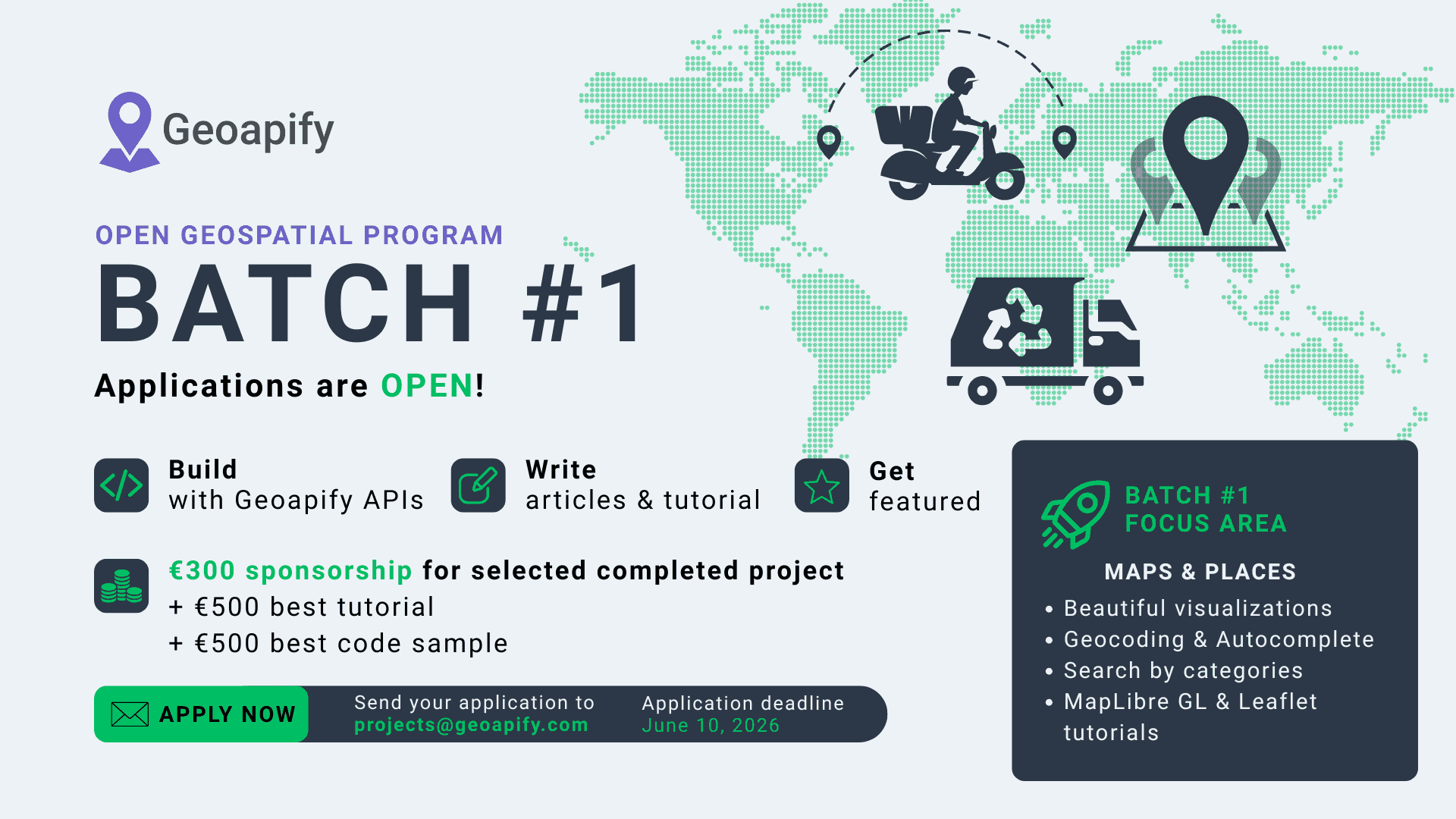
Batch #1 focused on practical maps and places projects built with Geoapify APIs. Applications closed on June 10, 2026. Its theme included map rendering, location search, geocoding, and place discovery; this section remains as a record of the earlier batch.
FAQ
Who can apply?
Developers, students, data analysts, and technical creators can apply if the project matches the Project Requirements.
Can individuals and teams both apply?
Yes. Individuals and teams are both welcome. Use one application email and clearly identify the main contact person in How to Apply.
Do I need to use a specific programming language or framework?
No. You can use any language or framework if the final project is public, runnable, and documented.
Can I use OpenAPI, MCP, or both?
Yes. Batch #2 accepts projects using Geoapify OpenAPI specifications, Geoapify MCP, or both. Choose the approach that fits your project and explain how you used it.
Is a hosted demo or complete app required?
No. A script, agent, component, workflow, or experiment can qualify if reviewers can run or reproduce its core flow using your README. An AI client setup guide can replace a hosted demo. See Project Requirements.
When are Batch #2 applications due?
Send your proposal by October 20, 2026, at 23:59 UTC. Applications open October 1. See How to Apply for Batch #2.
Do I need to answer every application question?
Yes. Copy the complete template into your email and answer every question. Write "Not applicable" when needed instead of deleting a question or leaving it blank. Incomplete or non-responsive applications may not be reviewed. See How to Apply for Batch #2.
Can I submit an existing project, or must it be new?
Both are possible. You can submit an existing project if it has not participated in this program before and it meets all Project Requirements.
What makes a project eligible for rewards?
Rewards depend on final review quality and completion criteria described in What Participants Receive and Program Terms.
What happens if my final submission has issues?
Geoapify may send a fix request if there are issues such as non-working links or missing setup steps. See Submission review and fix policy.
Will I get a chance to fix issues after review?
Yes. Each project includes one formal fix round. Timing and conditions are described in Submission review and fix policy.
How and when are rewards paid?
Rewards are paid after final review and completion approval. Details are in What Participants Receive and Program Terms.
How are rewards paid if I cannot use PayPal?
PayPal is not required. EUR bank transfer through SEPA is preferred when your account can receive it, including eligible Revolut or Wise EUR accounts. International transfers, PayPal, or a country-appropriate marketplace gift card may be agreed case by case. State the methods you can receive in your application; see Program Terms.
Who owns the code and tutorial after submission?
Participants keep authorship of their code and content. See Program Terms.
Can Geoapify reuse my code or republish my tutorial?
Yes, Geoapify may reference, showcase, copy, or adapt submitted code/tutorials with attribution, as described in Program Terms.
Who is responsible for taxes related to rewards?
Participants are responsible for their own taxes and local reporting obligations. See Program Terms.
How many projects are selected per batch?
The number is not fixed and depends on submission quality and available program capacity. Selection is competitive and discretionary. See Program Terms.
Where can I ask questions before applying?
Send your questions to [email protected] before submitting your application.


